
Understand Wayne County Property Value
Wayne County property value can mean several different numbers. The assessor estimates true or market value for the tax roll, and Mississippi's class ratio then converts that figure to assessed value. A recorded deed may state a separate consideration. The tax card multiplies assessed value by millage. Every figure carries its own date, source, and purpose.
| Value | What It Is | Where |
|---|---|---|
| True or market value | The assessor's estimate under the state appraisal framework | Assessor appraisal record |
| Assessed value | True value multiplied by the applicable class ratio | Appraisal and tax detail |
| Recorded consideration | A transaction amount stated in a recorded instrument | Chancery deed index or image |
| Land and improvements | Components contributing to the parcel total | Appraisal card |
Assessed value is built for tax calculation, not for predicting a negotiated price. A recorded consideration is a transfer fact. It may need the full deed for context. A private appraisal answers yet another valuation question on its own stated effective date.
Wayne Values in One Card
The appraisal card separates land, improvements, and total value. Its land line was 1,310. Improvements totaled 4,620, giving a parcel total of 5,930. The linked tax detail showed an assessed value of 890. Those figures teach the record structure. They describe one parcel and one displayed tax year, not a typical Wayne County home or a current sales trend. The Wayne County appraisal sample shows the value components beside its parcel, PPIN, legal description, situs, and owner mailing fields.
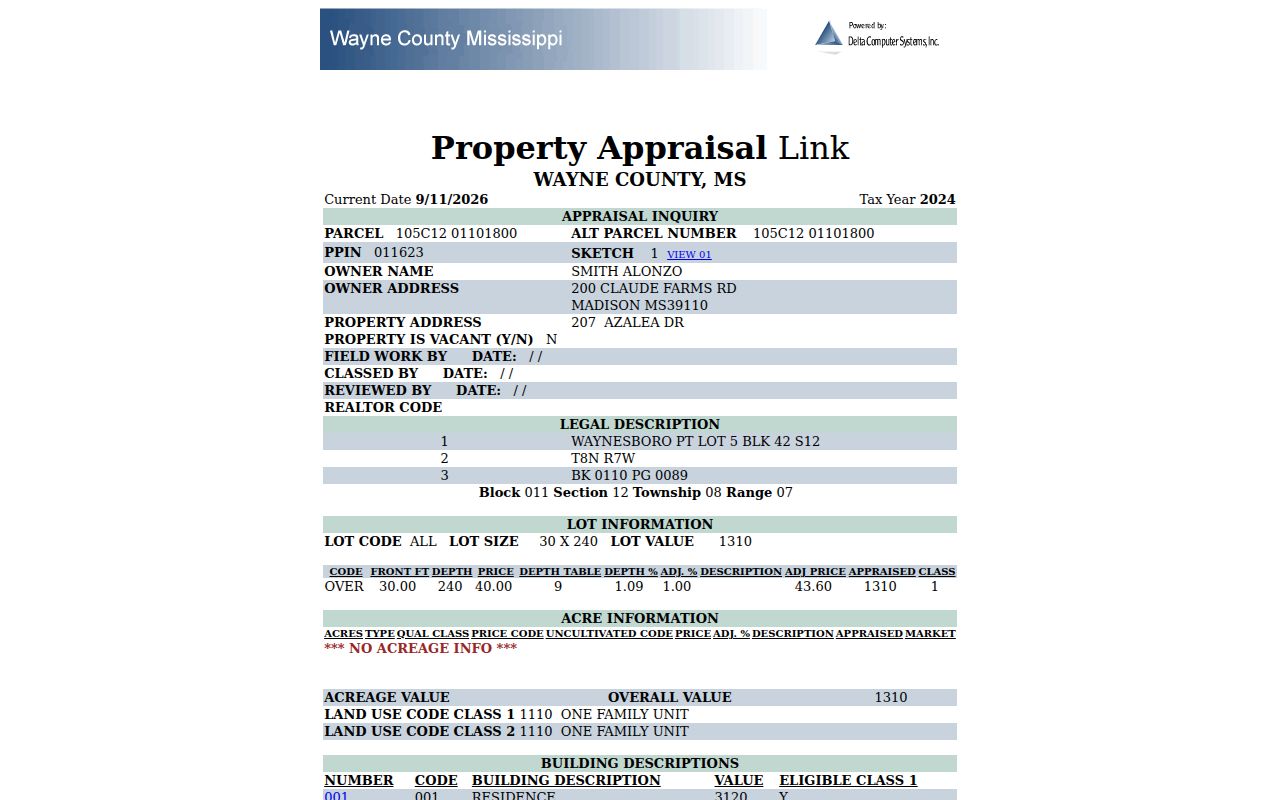
The card shows no last-sale field. That absence matters. Anyone seeking a transaction price must turn to the recorded deed instead of treating the parcel total as a sale amount.
Note: The Wayne sample is a field-by-field example, not evidence of a countywide property value trend.
Mississippi Ratios Set Assessed Value
Mississippi's local appraisal framework uses classes rather than one universal level of assessment. Class I covers single-family, owner-occupied residential real property at 10 percent of true or market value. Other real property, outside Class I and public utility property, is generally Class II at 15 percent. Personal property also uses 15 percent. Public utilities and motor vehicles use 30 percent. The formula is direct. True or market value times the class ratio equals assessed value. Assessed value times millage equals tax. A Wayne County card may hold multiple components and class details, so dividing one total may not explain every line. Read the card's own class and value breakdown.
- True or market value
- The assessor's full-value estimate under the state system.
- Assessed value
- The class-adjusted figure used in tax calculation.
- Assessment ratio
- The class percentage applied to true value.
- Consideration
- The transfer amount stated in a deed or index, distinct from assessed value.
- Reappraisal
- A periodic review of property values across the jurisdiction.
Look Up Wayne Property Value
Use the assessor's record when you need the value carried on Wayne County's tax roll. Start with the strongest key available. PPIN and parcel number cut ambiguity. An address works when no identifier is known. Match the situs and legal description before recording the values, and preserve the displayed tax year and database date.
- Open the Wayne real-property appraisal search.
- Search by address, name, parcel number, or PPIN, then confirm the correct situs and legal description.
- Record land, improvement, total, assessed, class, tax year, and update date fields that actually appear.
- For transaction value, search the Chancery instrument and read its consideration or complete deed image.
The online database can lag the courthouse. For a correction, a prior roll card, or a class explanation, contact the Tax Assessor-Collector at 609 Azalea Drive in Waynesboro. The office also takes calls at 601-735-2588. A narrow public-records request may ask for existing prior cards by PPIN and tax year.
Wayne Value Dates Are Different
Wayne County value dates are not one date. The tax roll carries a tax year. The database carries an update date. A retrieval date is your own. None of these is automatically the effective date of a private appraisal or a recorded conveyance. Mississippi taxes are assessed each year to the owner of record on January 1. State guidance generally requires reappraisal at least every four years. Between those points, changes to improvements, classification, ownership, and exemptions may reach the public interfaces on different schedules. Compare like tax years. One current card cannot establish a trend. A careful comparison labels each observation with its parcel or PPIN, tax year, database update date, and retrieval date. Keep the fields matched on both sides. A change in total value may reflect land, an improvement, or class treatment, so preserve those components too. One more habit helps. If prior cards are not online, ask the Wayne County assessor for existing roll cards by PPIN and year.
Wayne Sale Price Lives Elsewhere
Wayne County keeps its sale amounts in more than one place. The Chancery portal lets you search by consideration value. The assessor may also ask about purchase price and comparable sales when valuing a parcel. Yet the appraisal card shows no last-sale field. For a transaction amount, the recorded deed remains the stronger public source, read in light of the instrument's wording.
A stated consideration is not always an open-market price. Quitclaims, estate transfers, corrective deeds, trustee's deeds, and transfers between related parties can all skew the number. Check the instrument type first. Then read the parties, the file date, the legal description, and the full deed before relying on the figure. The Chancery index is informational. Fields can be incomplete or misspelled. Buy a certified copy when the figure carries legal weight.
Search the Wayne Chancery index by parties, date, instrument type, parcel, or legal description. The portal warns that its data is not certified. A consideration figure is a deed fact only, not proof of current market value, arm's-length terms, or present condition.
Note: When a sale and assessment differ, cite both source dates before drawing any conclusion about Wayne County property value.
Homestead Changes Wayne Taxable Math
Homestead status changes the tax math. It does not change what a deed price means. Wayne accepts homestead applications each year from January 2 through April 1. A new filing is required after an ownership change, a spouse's death, a divorce, a sale, or the purchase of another home. A blank online field just reports that one record. It is not a final ruling on eligibility.
For exemption details, use the Wayne County filing instructions and confirm status with the assessor. Tax bills and appeals belong on the Wayne County property tax records page.
Limits of Wayne Property Value
A Wayne County assessed value is a tax-system number. It cannot say what a buyer will offer, what a seller will accept, what repairs cost, or what an easement does to a price. The figure also says nothing about condition on a later date, and it does not prove that an improvement is permitted, that a parcel boundary is accurate, or that title is clear.
Each question has its own source. The assessor handles tax classification. The Chancery clerk's recorded deed documents a transfer. A market opinion tied to a sale or a dispute calls for a licensed appraisal with a clear effective date and scope. Label every figure by type so value does not blur these distinctions.
Wayne County publishes no verified citywide or countywide value-trend dashboard. A single parcel, public notice, or tax-year card cannot carry a broad trend claim. A real study would need consistent property classes, the same fields across multiple years, and a stated selection method. That dataset does not exist here. The reliable answer stays parcel-specific and dated.
Value is not price. Wayne County assessed value supports taxation. It is neither a guaranteed sale price nor a private appraisal.