
Read Wayne County Tax Records
A Wayne County tax account blends two kinds of public data in one view. The appraisal side names the parcel. It values the land and any improvements. Collection is the other half, reporting the amount billed, the amount paid, any balance, and tax-sale history on the account. The Tax Assessor-Collector performs both roles. A name on the roll is not a deed, and an assessed figure is not a sale price, so read each field for the question it actually answers.
| Field | What It Shows | Where |
|---|---|---|
| Land and improvements | Separate components used to reach the parcel total | Delta appraisal and tax cards |
| Assessed value | The class-adjusted amount to which millage applies | Delta tax detail |
| Homestead code | The exemption status displayed for the selected tax year | Delta tax detail |
| Due, paid, balance | County, city, school, penalty and total lines | Delta tax detail |
| Tax-sale history | The portal's displayed history for that account | Delta tax detail |
The Wayne County Delta portal is where the county puts its tax records online. A notice on the portal says uploads happen often. They can lag behind what sits at the courthouse. Need a current total, a correction, or a paper copy? The Wayne County Tax Assessor-Collector at 609 Azalea Drive in Waynesboro handles those requests. Call the assessor line at 601-735-2588 or the collector line at 601-735-3381.
A Wayne County Tax Snapshot
Any Wayne County tax detail comes with dates and labels. Those labels matter more than the numbers. One account on the county system shows why. It carries tax year 2024, yet the page reports records last updated September 12, 2025. The parcel total reads 5,930, with an assessed amount of 890. County, city, school, penalty, paid, and balance figures each sit on their own line. None of that describes countywide rates or today's market. It is one account, frozen at one date.
The official sample tax detail shows the layout a Wayne County property tax lookup produces. It lays out every line.
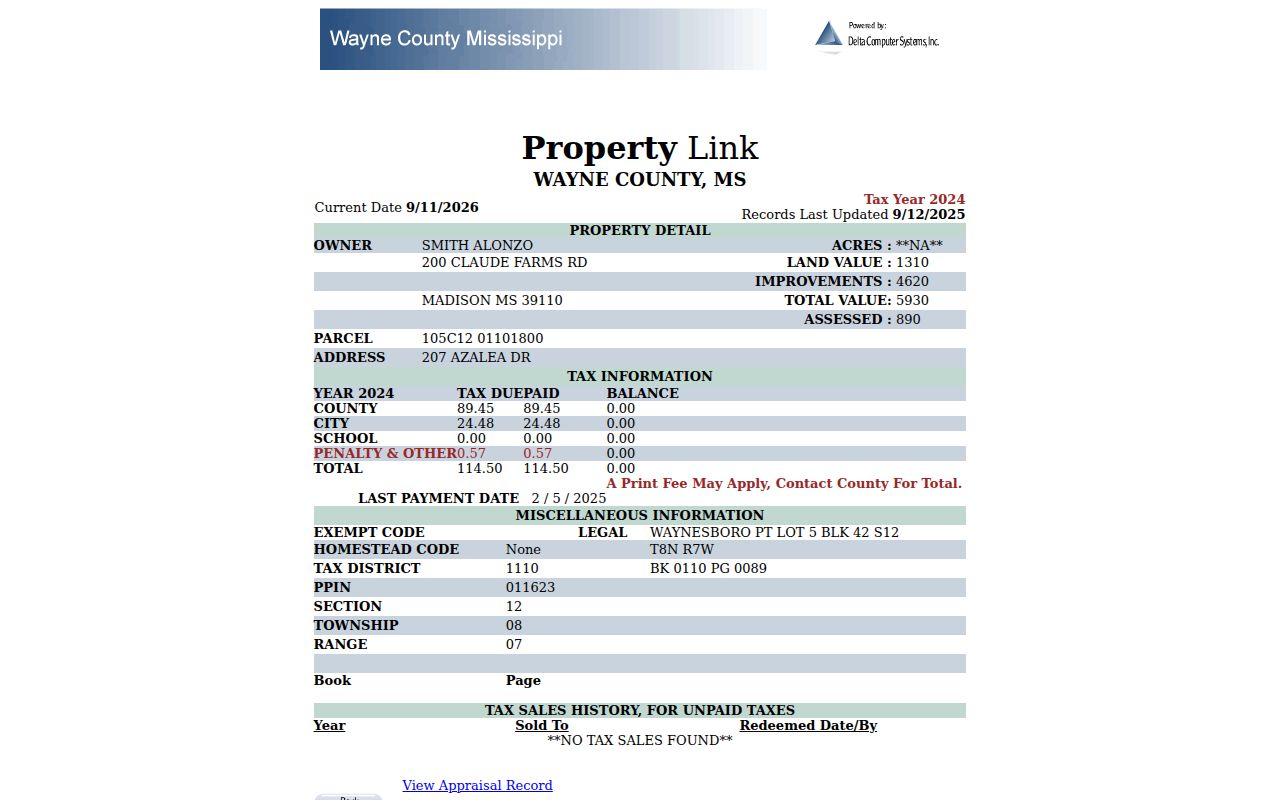
The screen separates value from assessed amount and payment status. Save the tax year, update date, PPIN, and parcel number with any printout so another reader can repeat the lookup.
Note: A portal update date describes the database refresh, while the tax-year label identifies the assessment cycle displayed.
Wayne County Tax Search Keys
The tax/property-link form takes several routes to an account. An exact PPIN is quickest when you already have it. A full parcel number preserves the vendor's spaced identifier. Name and address work as discovery tools. Section, township, and range cover rural land with a weak or missing street address. The form offers no tax-year selector, so read the year from the result itself.
| Search field | Format or use | Required |
|---|---|---|
| Name | Last name, then first name | No |
| Address | Separate number and street controls | No |
| Parcel Number | Retain spacing exactly as displayed | No |
| Section / Township / Range | Useful land-location criteria | No |
| PPIN | Vendor property identifier | No |
The Wayne tax/property-link search opens with no login required. Its form lists the search keys you can use, letting you query Wayne County parcels by owner name, parcel number, or address.
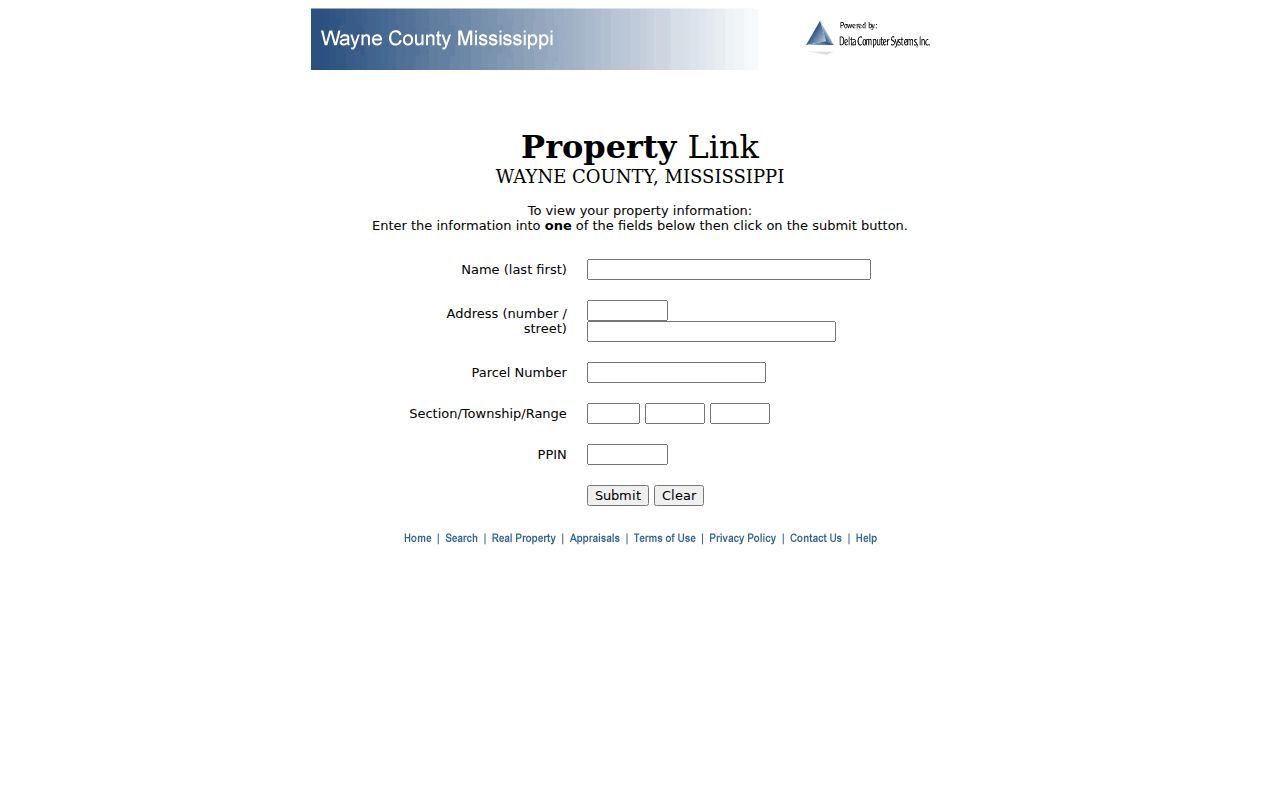
Lead with one strong key. Broad criteria can return a long result list, and telling similar names apart then takes the parcel, legal description, and situs address.
Look Up Wayne County Tax
Run it like an audit trail. Start at the county-linked Delta service, not a copied payment page. Match the result to the legal description and situs. Then open the tax detail through the PPIN. The account may hold separate county and city lines, plus penalties or other charges. A zero balance means the account is paid. It does not rule out other liens or recorded claims.
- Open the property-link form and search by PPIN, parcel, address, name, or land-location fields.
- Match the property address, owner display, parcel string, and legal-description shorthand.
- Record the tax year, database update date, each due/paid/balance line, and last payment date.
- Read the homestead and tax-sale fields, then call the collector for a current payoff or print fee.
- Assessed value
- The class-adjusted portion of true or market value used in the tax formula.
- Millage
- The local levy applied to assessed value to calculate tax.
- Homestead exemption
- Tax relief for a qualifying homestead, subject to filing rules.
- Tax lien
- A legal claim arising from unpaid property tax, distinct from a portal balance line.
The county's 2025 payment notice covers the practical details. Card payments carry a 3.75% nonrefundable fee. Offices keep weekday hours of 8 a.m. to 5 p.m., and a call before paying is wise when an exact total matters.
Mississippi Ratios Shape Wayne Tax
Mississippi applies different assessment ratios by property class. Owner-occupied single-family residential real property is Class I, assessed at 10 percent of true or market value. Most other real property, outside Class I and public utility property, lands in Class II at 15 percent. Personal property also runs 15 percent. Public utilities and motor vehicles each use a 30 percent class.
The math is simple. True value times the class ratio equals assessed value. Assessed value times millage equals tax. A mixed Wayne County card can hold land and improvements whose class details must be read rather than guessed from the total. The Mississippi DOR appraisal guidance also describes regular reappraisal, generally at least every four years.
Note: A class ratio explains the assessment calculation; it does not predict what a buyer would pay for the parcel.
Wayne County Homestead Timing
Wayne County's homestead filing instructions set a January 2 through April 1 application window. Filing is normally one-time. The county still directs owners to file again after an ownership change, a spouse's death, divorce, a sale, or purchase of a new home. The statewide DOR homestead page adds broader eligibility context.
A blank exemption field cuts both ways online. A Homestead Code of None does the same. Neither is a final legal decision, only a report of what the selected account displays for its tax year. Ask the assessor whether an application is pending, whether a change required refiling, and what proof the office needs. Exemption affects taxes, not the deed.
Wayne Tax Sales Need Context
One Wayne County account returned "NO TAX SALES FOUND." That message covers a single property records query. It is not a countywide finding. It also says nothing about title. It does not prove that no recorded tax instrument exists in the Wayne County deed records. Delinquency and a scheduled auction are separate events. A completed sale, redemption, a tax deed, and a later release are separate too. They are kept in different property records.
The state holds its own inventory. The Mississippi tax-forfeited land search filters by county. It also filters by parcel, PPIN, owner, legal description, value, and section-township-range. Each result supports a detail view, a map, an application, or an auction workflow. Listing in that inventory still does not prove a sale closed. It does not prove that title is clear either. Search the Wayne Chancery index for Tax Deed and Tax Sale Release instruments whenever the chain of title matters.
Keep the event straight. A tax-card history or forfeited-land listing is a dated lead. Confirm the later recorded instrument before relying on ownership status.
The Secretary of State search offers a second filter set when a Wayne County property tax result comes back thin. County is the required starting choice. From there the fields are optional. Address, city, ZIP, subdivision, parcel number, PPIN, assessed owner, legal description, market or assessed value, and section-township-range all narrow the property search. Results appear ten at a time. A hit may open a detail or map route. Save the exact result label and the query date before entering any application or auction workflow.
Recorded land instruments complete the delinquency review. Wayne Chancery's instrument list includes Tax Deed, Tax Sale Release, Notice of Lien, and related categories. Search the account name in both party directions. Then match it with parcel and legal terms. The first scanned page may not carry the full legal description, and later pages can require purchase. When the event affects a purchase or redemption question, request the complete instrument at the clerk's office.
Appeal a Wayne County Assessment
An appeal challenges the valuation, not the title. Pull the assessment card first. Check the tax year, class, land value, and improvement value for anything that looks wrong. Comparable sales, photographs, measurements, and repair facts can frame the issue. So can records showing a classification error. Contact the assessor early, since local review steps and notice dates vary.
The Mississippi DOR appeal guidance maps the normal route to the Wayne County Board of Supervisors by the first Monday in August, before the tax is due. Confirm that deadline for the current cycle. Keep copies of the appeal, the evidence, the notice, and any board action. A portal refresh can run on its own schedule.
Separate the source facts before filing. Ask whether parcel dimensions, the improvement description, class, land value, or the homestead field are the real points in dispute. Match photos to the same tax year. Don't mix current conditions with an older roll. The assessor may also hold prior appraisal cards that the public form does not show. A narrow request for those existing cards can reveal when a field changed and give the Board a cleaner record.
Protect the appeal window. The normal deadline is the first Monday in August. Confirm the current Wayne County notice with the assessor before relying on it.